
Raising Our Vibration
Reaching Enlightenment: A Transformative Journey Into the Divine Expansion of the Universe.
- LEVEL 1: The In-Out Exercise
- LEVEL 2: The In-Hold-Out-Hold Exercise
- LEVEL 3: Divine Light
- LEVEL 4a: The Seven Chakras – Tratak
- LEVEL 4b: The Seven Chakras – Within Body
- LEVEL 5: Raising Our Vibration
LEVEL 1: The In-Out Exercise
The In-Out exercise is a simple practice of inhaling to a count of four, exhaling to an equal count of four, and then repeating the cycle without pausing. It is extremely important that our breathing follows a steady rhythm and tempo—we should always maintain the same count as we inhale and as we exhale.
Complete the following five-minute meditation exercise:
- Inhale from your nose as you mentally count to four.
- Exhale from your nose as you mentally count to four.
- Repeat the cycle until you reach the five-minute objective.
Tips for This Exercise and Following Exercises:
- If you are having any difficulties breathing solely from your nose, you may also breathe with your mouth.
- As we inhale, we must first lower our diaphragm and expand our stomach until it is filled with air, we can then slowly expand our chest as we fill our lungs with air.
- As we exhale, we must raise our diaphragm and suck our stomach in as we release the air from our lungs and stomach.
- Having a metronome or a clock nearby with a tick loud enough to hear, but not too loud that it becomes distracting, is a great way of maintaining your focus and keeping a steady tempo.
- Holding the Jnana Mudra will have an uplifting effect on the mind and body (joining the tips of our thumbs and index fingers, forming a circle, with the back of our hands resting on the top of our knees/thighs and our palms facing up).
- Document your sessions, and always pay attention to breakthroughs and synchronicities as there are no such things as coincidences. You should also document your dreams or any lingering thought or idea as you wake up. We only have ten to fifteen seconds to write down our thoughts as soon as we wake up before our mind interferes and imposes rationality and logic.
Once you become comfortable completing this five-minute exercise, you can proceed with the next level (2).
LEVEL 2: The In-Hold-Out-Hold Exercise
The In-Hold-Out-Hold exercise is extremely powerful as it balances the relationship between our ego and our higher self. It is like the previous exercise, but we are now holding our breath after we inhale, and after we exhale. As in the previous exercise, it is extremely important that our breathing follows a steady rhythm and tempo—we should always maintain an equal count as we inhale, as we exhale, and as we hold both breaths.
Complete the following ten-minute meditation exercise:
- Inhale from your nose as you mentally count to four.
- Hold your breath as you mentally count to four.
- Exhale from your nose as you mentally count to four.
- Hold your breath once more as you mentally count to four.
- Repeat the cycle until you reach the ten-minute objective.
Tips for This Exercise and Following Exercises:
- Holding our breath after we inhale should be an easy task as we are fulfilling our ego with abundance but holding our breath after we exhale might be a struggle as we are stripping ourselves of our ego—and the ego will resist—and realigning our state of consciousness with our higher self.
- As our heart rate begins to slow down, we may also increase the count to six, eight, ten, or more, but the objective should never be to reach the highest count possible—our objective should simply be to maintain a comfortable and steady rhythm and tempo throughout the meditation exercise. If we do increase the count, we must do so as we inhale and then maintain that same count for all other steps (inhale, hold, exhale, hold).
- If we find ourselves gasping for air or tensing up, we must reduce the count for each step in the exercise as a meditation exercise should always be peaceful and relaxing.
Once you become comfortable completing this ten-minute exercise, you can proceed with the next level (3).
LEVEL 3: Divine Light
We may now bring healing to our four bodies (physical, emotional, mental, and spiritual) by visualizing divine light as we complete the In-Hold-Out-Hold Exercise.
Complete the following ten-minute meditation exercise:
- Inhale from your nose as you mentally count to four (or more) and visualize divine light entering your body (you may also increase the count during this step).
- Hold your breath (same count as previous step) and visualize divine light quickly moving within your body as it heals and reenergizes your four bodies.
- Exhale from your nose (same count as previous step) and visualize divine light carrying out all impurities from your four bodies.
- Hold your breath once more (same count as previous step) and visualize yourself in a state of purity.
- Repeat the cycle until you reach the ten-minute objective.
Immediately follow the exercise by remaining peacefully within for another ten minutes (stillness):
- You can now resume your normal breathing.
- You are no longer counting.
- You are no longer visualizing divine light.
Tips for This Exercise and Following Exercises:
- End with the total awareness of your physical body—bring your consciousness to the top of your head and slowly scan down your body until you reach the tip of your toes. You can then stretch out your arms and legs, move your fingers and toes, and when you are ready, you may open your eyes.
- If you struggle with visualization, simply believing in what should be taking place will be just as effective, and with time, you will surely develop and improve your visualization skills.
- As you remain peacefully within, you are aware of your physical body, but you must remain quiet, without any movement, thought, or emotion—it’s not about shutting everything out, but about paying attention to what surfaces and then releasing it peacefully. Whenever you realize that your mind has drifted, simply bring your focus back within, but if a disturbing or negative thought appears, you should visualize a divine hand manifesting above your head, grabbing your thought, slowly lowering it to your Manipura/Solar Plexus chakra, and then dissipating it in a divine white light.
Once you become comfortable completing this ten-minute exercise, you can proceed with the next level (4a).
LEVEL 4a: The Seven Chakras – Tratak
Print the following 7 images in color (this exercise will not work if you are staring at the images on a screen).

Muladhara, Root Chakra
Blue Square

Svadhisthana, Sacral Chakra
Charcoal Horizontal Crescent Moon

Manipura, Solar Plexus Chakra
Cyan Inverted Triangle

Anahata, Heart Chakra
Yellow Hexagram

Vishuddha, Throat Chakra
White Vertical Oval

Ajna, Third Eye Chakra
Black Winged Circle

Sahasrara, Crown Chakra
Black Rose
Complete the following meditation exercise (one chakra per day):
- Sit down comfortably and hold up the image of the first chakra at an approximate distance of one to two feet from your face.
- The image should be levelled with your eyes, with no light casting behind it.
- Stare at the image without blinking, until your eyes start to burn and a shimmering glow appears over and around the image.
- You may then close your eyes and concentrate on the image that remains in your mind (the chakra will appear in your mind in its original color – inverted from the printed color).
- Repeat the process once the image has completely faded (initially, the image will only remain in your mind for a fraction of a second).
- You can then end this exercise once you become comfortable holding the image of the chakra in your mind for a couple of seconds.
You can proceed with the next level (4b) once you have completed all seven chakras.
LEVEL 4b: The Seven Chakras – Within Body
We may now harmonize and reenergize our seven chakras (muladhara, svadhisthana, manipura, anahata, vishuddha, ajna, and sahasrara) by visualizing each chakra within our body in their three-dimensional shape and recite their Bija Mantra.
The seven chakras are circular vortexes of energy that can greatly affect our physical, emotional, mental, and spiritual bodies—especially if they are blocked, overactive, or inactive.

Muladhara, Root Chakra
A golden cube located at the base of the spine – Root of the physical body (physical health and strength).
It represents basic needs for survival and remaining anchored and grounded on the physical-material realm.
The Tarot Suit of Pentacles – The Element of Earth. Bija Mantra: LAM.

Svadhisthana, Sacral Chakra
A silver melon slice located two inches below the navel – Root of the emotional body (emotional health and strength).
It represents emotions, creativity, sensual pleasure, and sexuality.
The Tarot Suit of Cups – The Element of Water. Bija Mantra: VAM.

Manipura, Solar Plexus Chakra
A ruby-red tetrahedron located two to three inches above the navel – Root of the mental body (mental health and strength).
It represents willpower, confidence, and independence.
The Tarot Suit of Swords – The Element of Air. Bija Mantra: RAM.

Anahata, Heart Chakra
A blue sapphire merkabah located in the centre of the chest – Root of the spiritual body (spiritual health and strength).
It represents love, compassion, and forgiveness.
The Tarot Suit of Wands – The Element of Fire. Bija Mantra: YAM.

Vishuddha, Throat Chakra
A black marble egg located at the throat – Root of the will (the power to create/manifest our reality).
It represents self-expression, communication, and truth.
Bija Mantra: HAM.

Ajna, Third Eye Chakra
A white-winged sphere with the sun under its right wing, and the moon under its left wing, located between the eyes and above the brow line – The vehicle of the consciousness.
It represents wisdom and understanding, intuition, and psychic abilities.
Bija Mantra: OM.

Sahasrara, Crown Chakra
A clear white rose located just above the crown of the head – The channel for the higher self.
It represents divine knowledge, higher consciousness, and enlightenment.
Bija Mantra: Silent OM (speak in the universal language of love).
Complete the following ten-minute meditation exercise (one chakra per day):
- Sit up straight and close your eyes.
- Visualize the chakra in its three-dimensional shape and color, and in the correct location within your body.
- Recite the corresponding Bija Mantra:
- Muladhara Bija Mantra: LAM.
- Svadhisthana Bija Mantra: VAM.
- Manipura Bija Mantra: RAM.
- Anahata Bija Mantra: YAM.
- Vishuddha Bija Mantra: HAM.
- Ajna Bija Mantra: OM.
- Sahasrara Bija Mantra: Silent OM (speak in the universal language of love).
Immediately follow the exercise by remaining peacefully within for another ten minutes (stillness).
You can proceed with the next level (5) once you have completed all seven chakras.
LEVEL 5: Raising Our Vibration
We must no longer count mentally as we need our mind to focus entirely on the visualizations—count subconsciously with your right hand as you move your thumb over each third of each finger.
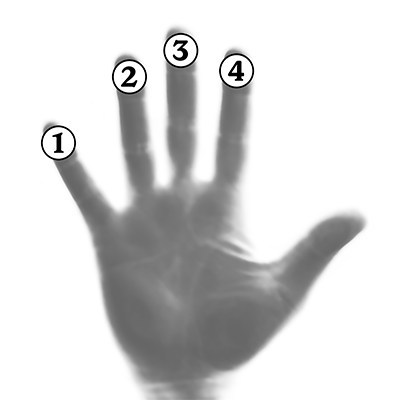
Counting to 4
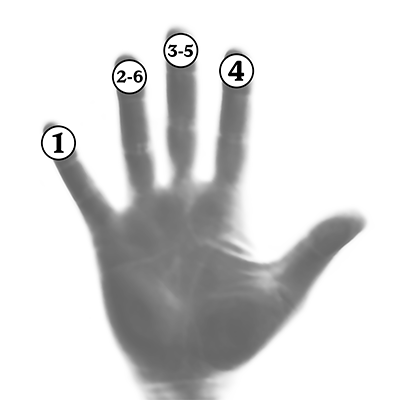
Counting to 6

Counting to 8

Counting to 10
Perform the “LEVEL 3: Divine Light” meditation for 10 minutes (skip the stillness step).
Perform the “LEVEL 4b: The Seven Chakras – Within Body” meditation (skip the stillness step).
- Perform this exercise for all 7 chakras:
- Begin with the first chakra (Muladhara) and once you can feel it vibrating and pulsating with energy, proceed with the next one (trust your intuition).
- Repeat until all 7 chakras have been activated.
Immediately follow the exercise by remaining peacefully within for as long as you desire (stillness):
- Visualize yourself as a shining bright star in the centre of the universe.
There is no time limit for this exercise, you must enjoy every aspect of it, and not rush any part of it.
Everything that comes to mind is channelled—every thought, inspiration, or motivation, either comes from our higher self, a higher entity, or a dark entity. Reaching enlightenment is essential to move past the grasp of darkness.